The Rogue AI Detection System
Is your AI still doing what you think it’s doing?
Most AI vendors can only offer their own word that their systems can be trusted. RAIDS is the smoke detector for your AI in production: always-on, independent monitoring that learns what's normal for your AI system and alerts you the moment something deviates, before your customer, your auditor, or a bad headline finds out first.
Evidence for EU AI Act monitoring duties, Articles 26 and 72
Aligned to ISO 42001 controls
Annex III high-risk obligations apply 2 December 2027
Why now
AI adoption has outpaced AI oversight
AI passes review, then surprises you once it’s live: a chatbot jailbroken within days, a lending model quietly discriminating, a legal AI citing cases that don’t exist. One approval isn’t oversight.
$4.3B+
Estimated financial losses from AI-related risks across 975 companies surveyed
+55%
Rise in reported AI incidents, year over year
70% vs 14%
Organizations with formal AI risk committees vs. those ready to actually deploy
€35M
Maximum EU AI Act fine per violation, or 7% of global revenue
How it works
Watch the behavior, not the code
RAIDS monitors what goes into your AI systems and what comes out. No access to model internals, training data, or vendor code. That keeps the monitoring independent, and it’s why RAIDS works with any AI system.
Name your system, upload a baseline, and connect through API.
RAIDS learns what normal looks like for your system specifically.
Deviations are scored and classified in real time, from sudden breaks to slow drifts.
Every detection comes with the reasoning behind it, an evidence trail for auditors, regulators, and enterprise customers.
What you get
Earning trust
It rarely comes down to price: the demo goes well and pricing gets agreed, then a risk team asks who’s watching for drift and nobody has an answer. Here’s what RAIDS changes.
One trust score for leadership
The AI Trust Score gives your board one number, tracked over time, for how your AI is actually behaving in production.
Protect your brand
Hallucinations, bias, and abnormal outputs are flagged as they happen, before they become the next screenshot circulating on LinkedIn.
A stronger risk position
Real behavioral data backs your insurance conversations and gives regulators the independent oversight they expect.
Keep enterprise deals moving
78% of business leaders lack full confidence they could pass an independent AI governance audit, and buyers increasingly want evidence they can verify.
Audit-ready in weeks, not months
ISO 42001 evidence normally takes 6 to 12 months to gather by hand, but RAIDS collects it continuously, so your audit has what they need in about 6 weeks.
Proof, not promises
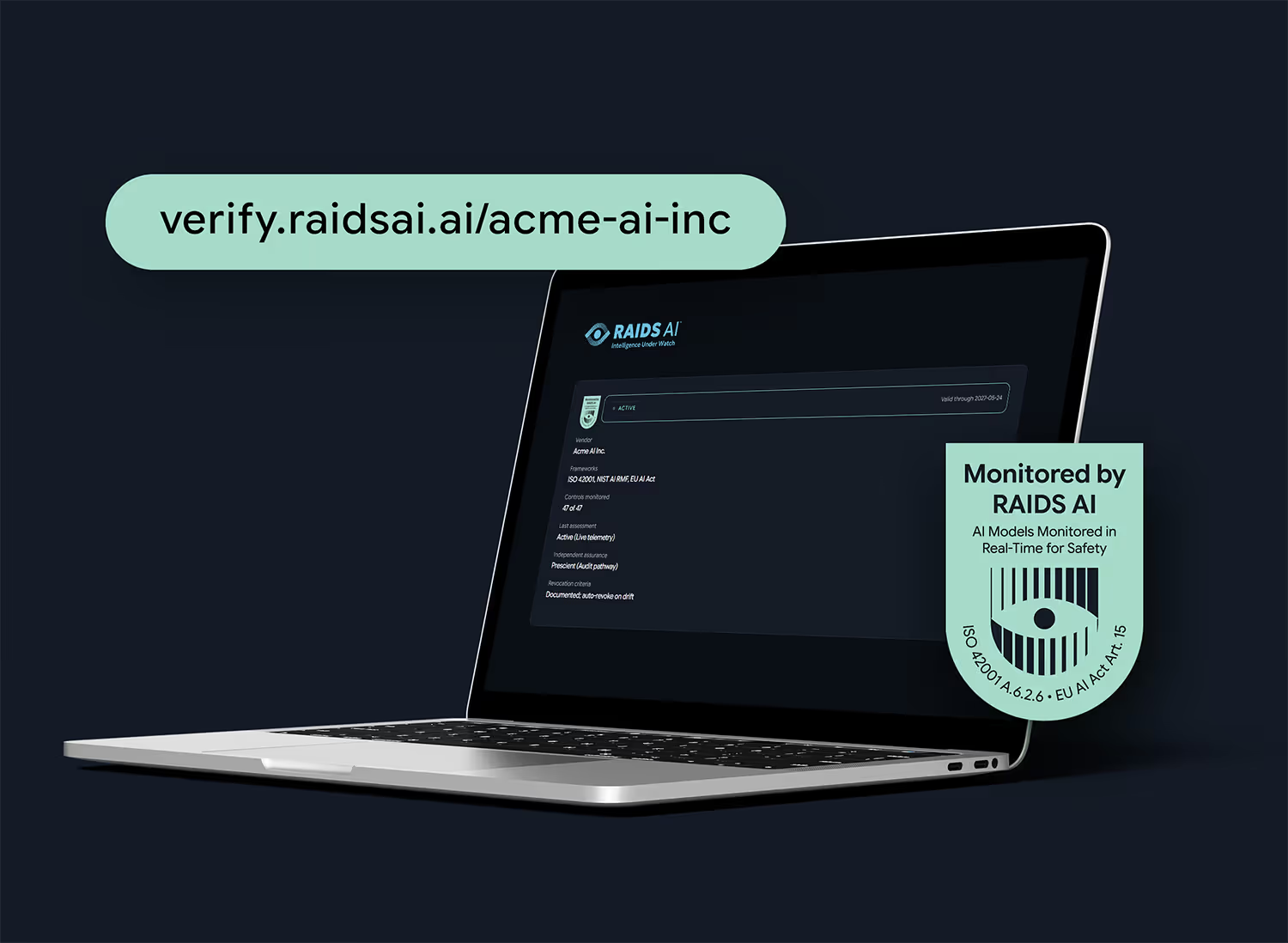
Every RAIDS customer gets a seal. This is what turns “trust us” into something a risk team can actually sign off on: a live attestation that monitoring is running right now, not a static badge from months ago. Put it on your website, in your docs, your security questionnaire, anywhere a buyer needs tangible proof. Attach it to an RFP response, and it can answer the governance question before it becomes a blocker.
Coming soon
RAIDS Browser Extension
Our AI monitoring layer is now coming to your browser, starting with ChatGPT. The RAIDS Browser Extension checks every response as it arrives and flags anything rogue, showing you the indicators behind the score, so you can double-check before you send, share or act on it. It all happens in your browser, with nothing new to open and no need to leave the chat. Free during Beta.

Apple continues to be one of the most fascinating companies to watch this earnings season. Its ecosystem strategy, from hardware to services, has created a level of customer loyalty that few companies can match, and that loyalty shows no signs of slowing down.
 My UsageLog out
- The prompt and the response were 24% similar.
- The sentiment of the prompt matched that of the response.
- One out of the four entities mentioned in the prompt were referenced in the response.
- The response was 50 words long.
- It took 3.1 seconds for the response to be generated.
- No repetitions were detected in the response.
Yes. RAIDS is built for AI vendors and builders, whatever you’re building on top of, wherever it’s deployed. If you’re shipping AI in production, RAIDS monitors it.
Large language models, structured or tabular models, and time-series models, each with its own detection approach. If it’s making decisions in production, RAIDS can watch it.
No. RAIDS analyzes inputs and outputs only, never model weights, code, or training data, and monitored data can be anonymized first. That's a deliberate design choice: it's what keeps the monitoring independent.
It turns every interaction with your system into measurable behavioral signals and compares them against a learned baseline of normal behavior. When something doesn't reconcile with that baseline, it's classified and scored by severity in real time.
Observability tracks technical performance and needs model access. Security tools defend against external attacks. GRC platforms manage documentation and workflow. RAIDS covers the gap between them: independent monitoring of how your AI behaves once it's live, producing evidence those other tools can use. It complements a platform like Drata rather than replacing it.
No. Compliance is your organization’s responsibility, RAIDS provides the continuous monitoring evidence that supports it. Both frameworks expect ongoing oversight, not a one-time assessment, and that's what RAIDS automates the evidence collection for. For specific provisions, like ISO 42001 A.6.2.6 or EU AI Act Article 72 (the Post-Market Monitoring System obligation), RAIDS is your real-time monitoring solution.
Name your system and select its type, provide a baseline (upload past interactions or connect live), and finish the API integration using the integration guide. Monitoring runs in the background, it doesn't sit in the inference path or change how your model runs. Support is available throughout at support@raidsai.ai.
Connect live instead. RAIDS establishes the baseline by observing real traffic from day one.
An alert with the classification, severity, and the reasoning behind it: which behaviors deviated and by how much. Your team investigates from the explanation, not raw logs, and can feed back on any detection to tune it further.
Featured Stories


Our Team
RAIDS is built by founders and researchers with decades in AI and AGI innovation, a core team that brings it to market, and engineers who hold it to the highest standards, backed by strategic advisors spanning AI, technology law, and cybersecurity.
Leadership
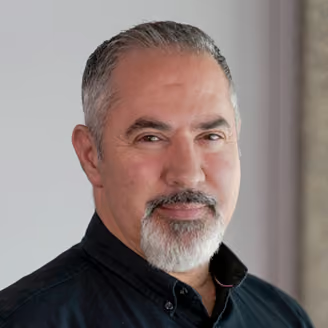
Nikolas Kairinos
40+ years in AI/AGI innovation, founding startups and integrating intelligent systems into real-world applications.
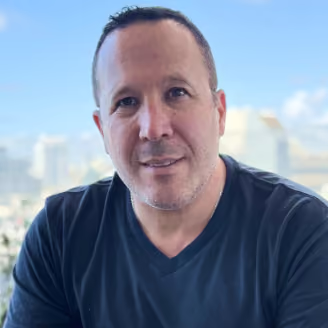
Brett Stonefield
35+ years driving innovation in technology and trading, from founding startups to achieving global market adoption.
Strategic Advisors

Evdokia Marcou
Corporate lawyer focusing on fintech, blockchain and AI, Cyprus Bar member, ISO contributor and Senior Research Officer.

Christiana Aristidou
Technology law expert with 25+ years of experience, Leader of The Hybrid LawTech Firm, and contributing to ISO standards in AI.

Yoni Schamroth
AI expert with 20+ years of experience, previous Global Director of Machine Learning at WeWork, with expertise from Fiverr.

Yair Cohen
Former head of Unit 8200 and a retired IDF Brigadier General, founder of Elbit Systems' Cyber Division and CEO of Ayah Group.
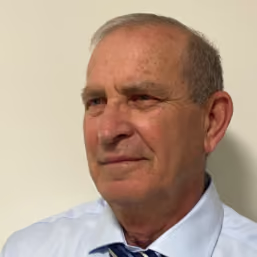
Naftali Granot
Former Mossad Deputy Director with 25 years in Israeli intelligence, former CEO in the mining sector and a security company board member.

Dorit Sfadyah
Technology leader with 18 years of global AI experience, former Fiverr and WeWork executive, scaling strategic AI solutions.
Core Team

Nicole Kairinos
Owns the product roadmap, keeps the R&D team aligned on priorities and quality standards, and shapes RAIDS' core messaging strategy.

Franki Friedman
Leads strategic partnerships and go-to-market across the AI ecosystem, connecting AI vendors and technology providers with enterprise trust and governance.

Rita Papadakis
Keeps operations running smoothly, backed by 30+ years supporting founders and senior executives across diplomatic, technology, and innovation-driven organizations.
Partnerships
Working with the Partners your clients already trust
Interested in partnering with RAIDS? We'd love to hear from you.


See the evidence, not the pitch
One demo shows you the dashboard, the trust score, and the evidence trail your buyers will eventually see too.